
Print, radio and podcast ads have one old problem: you rarely know which ad brought the visit. Google’s own GA4 help lists offline documents among the reasons traffic shows up as (direct)/(none). People type the address or scan a code, and the source is lost.
The usual fix is a separate short link for every placement, with UTM tags hidden in the long URL behind it. Flyers, magazine ads, radio spots and podcast reads all work with the same setup.
Why do offline ads show up as direct traffic?
When someone types a web address from a poster, the browser sends no referrer. GA4 has nothing to tell it where the visit came from, so it files it under direct. Google’s help page on direct traffic names missing UTM tags and offline documents like PDFs as typical causes. The GA4 direct traffic post goes through all of them.
A short link solves both parts. It is easy to type or scan, and the long URL behind it can carry the UTM tags. The visitor never sees them, but GA4 does.
One short link per placement
The key rule is one link for one placement. If the same link sits on a flyer and in a radio spot, the clicks can’t be split later.
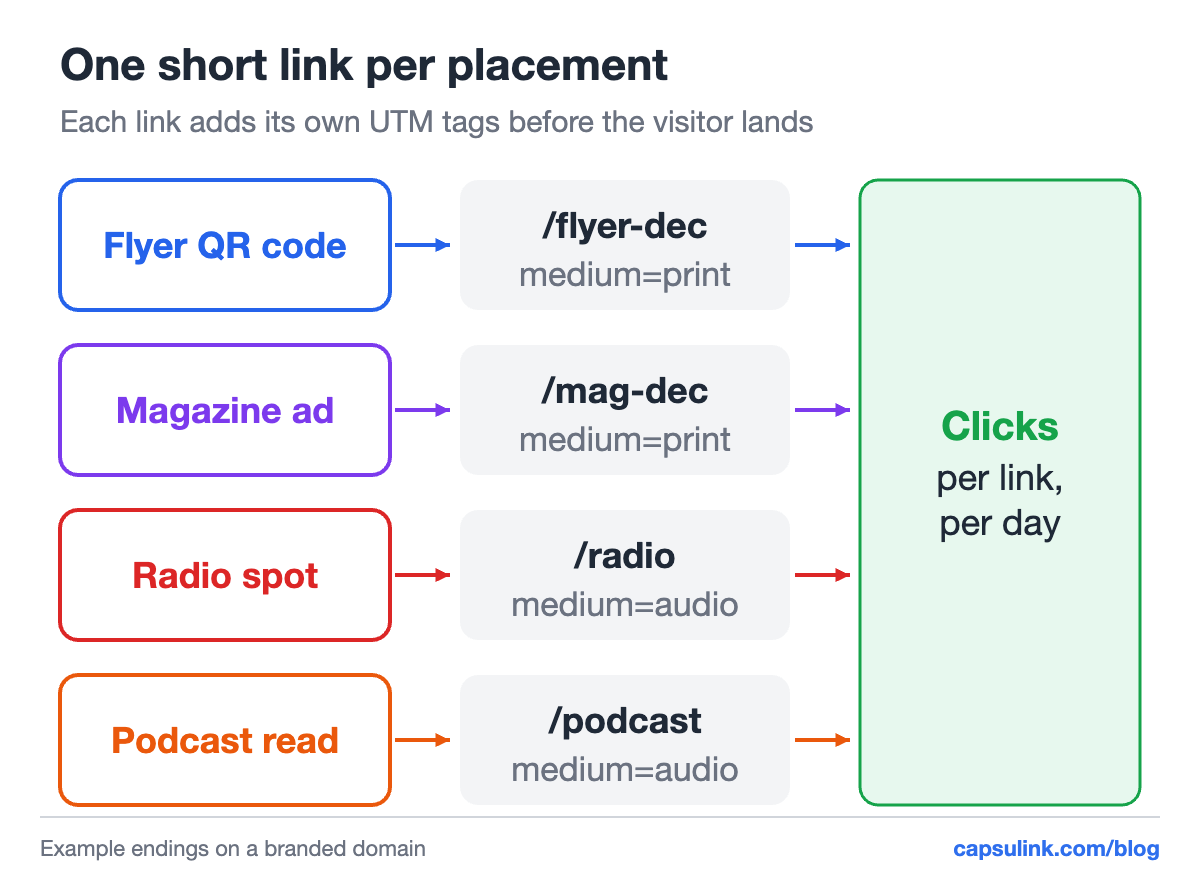
Each placement gets its own short link and its own click count
A simple plan for a December campaign could look like this:
| Placement | Short link ending | utm_source | utm_medium |
|---|---|---|---|
| Flyer with QR code | /flyer-dec | flyer | |
| Magazine ad | /mag-dec | city-magazine | |
| Radio spot | /radio | radio-station | audio |
| Podcast read | /podcast | show-name | audio |
Every row uses the same utm_campaign, for example winter-2026, so GA4 can show the whole campaign and then split it by source. The UTM parameters guide has the naming rules, and Capsulink’s article on GA4 campaigns and conversions shows how the tagged links appear in reports.
How to track print ads and flyers
Print can carry a QR code, so use one. A short link keeps the code small. In Capsulink’s measurement on 2026-11-26 at error correction level M, a 110-character URL with UTM tags needed a version 7 code with 45 x 45 modules. A 22-character short link fit in version 2, with 25 x 25 modules. Fewer modules means bigger squares at the same print size, which helps on cheap paper and from a distance.
Print the short link as text under the code too. Some people still type it. Each print run with a different design or location deserves its own link, so “flyer at the gym” and “flyer at the cafe” stay apart. How to track QR code scans explains reading the numbers per code.
How to track radio and podcast ads
Audio has no QR code, so the link must survive being heard once and typed from memory. Two things help.
The first is a branded domain. “yourbrand.link/radio” is easier to remember than a random string on a generic domain. The custom short domain setup guide walks through the DNS part, and Capsulink’s help article on custom domain setup lists the records.
The second is an ending people can say. Real words work best, and letters that sound or look alike cause typos.
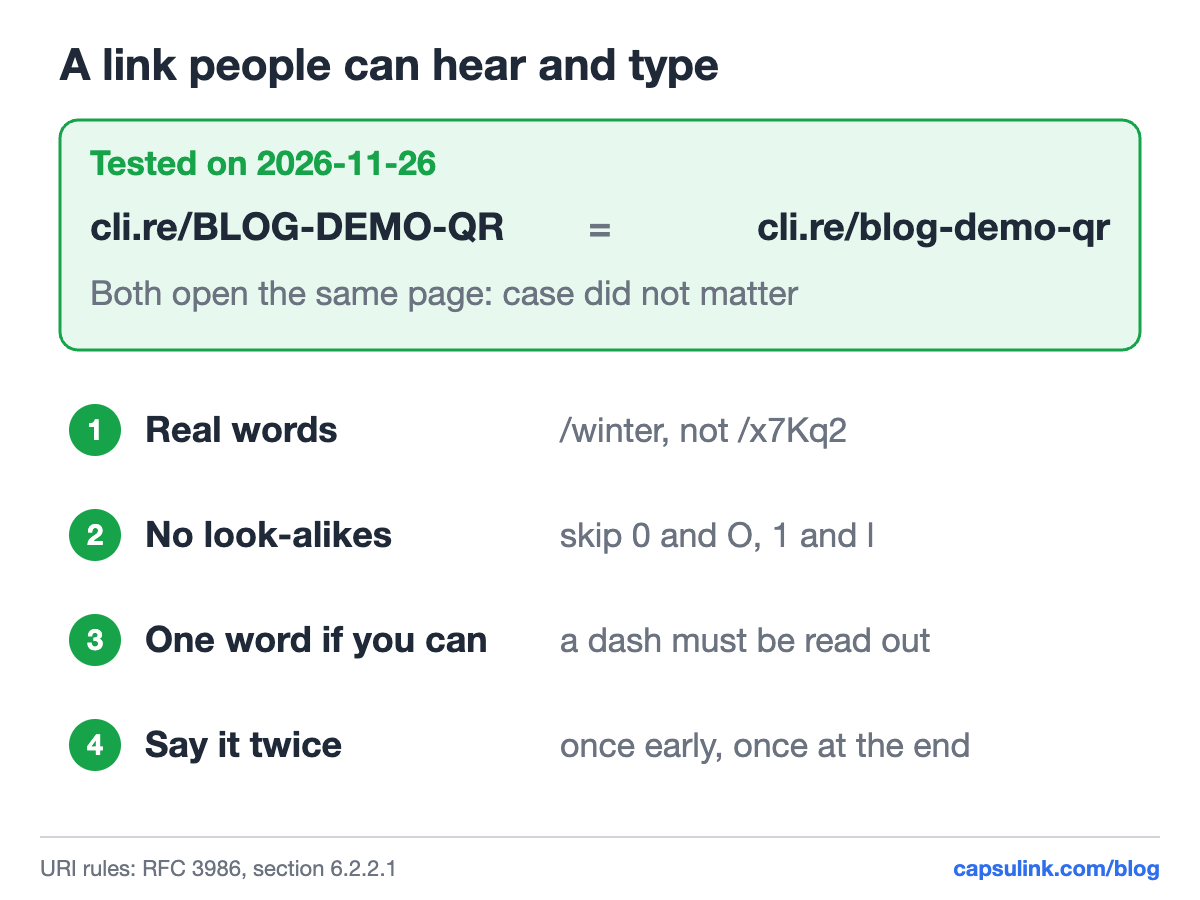
Endings that survive being heard once on air
Capital letters are a common worry for audio ads. The URI standard, RFC 3986, says the domain part is case-insensitive, but other parts of a URL are “assumed to be case-sensitive”. So the path can matter on some systems. Capsulink tested its own short links on 2026-11-26: cli.re/BLOG-DEMO-QR opened the same page as cli.re/blog-demo-qr. A listener who types capitals still gets there.
Podcast hosts often read ads in their own words. Send them the exact link and ask them to spell any unusual word. Capsulink has an older post on the role of podcasts in marketing if you are still choosing shows.
How to read the results
After the campaign, compare two numbers for each placement:
- Clicks on the short link in Capsulink. This counts everyone who opened the link, even if they block analytics scripts. The statistics article lists what each plan shows. On the free Starter plan you see the last 30 days, so export or note the numbers in time.
- Sessions and conversions in GA4, filtered by
utm_campaign. These tell you what the visitors did after they arrived.
The two numbers won’t match exactly. Ad blockers and people who leave before the page loads both cut the GA4 count. The gap is normal. What matters is the ranking: which placement brought the most clicks for the money.
Some people will still type your main website address instead of the short link. Those visits land in direct traffic. Treat your short link numbers as the lower limit of what each ad did.
FAQ
Can I use one short link for several radio stations?
You can, but you won’t know which station worked. Use one ending per station, such as /radio-a and /radio-b, if the budget split matters.
Do I need a paid plan to track offline ads?
The free Starter plan creates short links with QR codes and basic stats for the last 30 days. Pro ($10 a month) adds a custom domain, editing the destination and full stats, which helps for longer campaigns.
Should the short link go straight to the homepage?
Better to a landing page that repeats the offer from the ad. The listener heard “20% off winter boots”, so the page should show winter boots, not the full shop.
Can I change the destination after the ad is printed?
Yes, on paid plans. The printed link stays the same while the page behind it changes, as described in how to edit a QR code after it is printed.